

kdwvs.over-blog.com/
15 Décembre 2020

Git makes contributing changes back to the source of the fork as simple as asking someone from the original project to pull from you, or requesting write access to push changes back yourself. This is the part that GitHub makes easier, and standardizes.
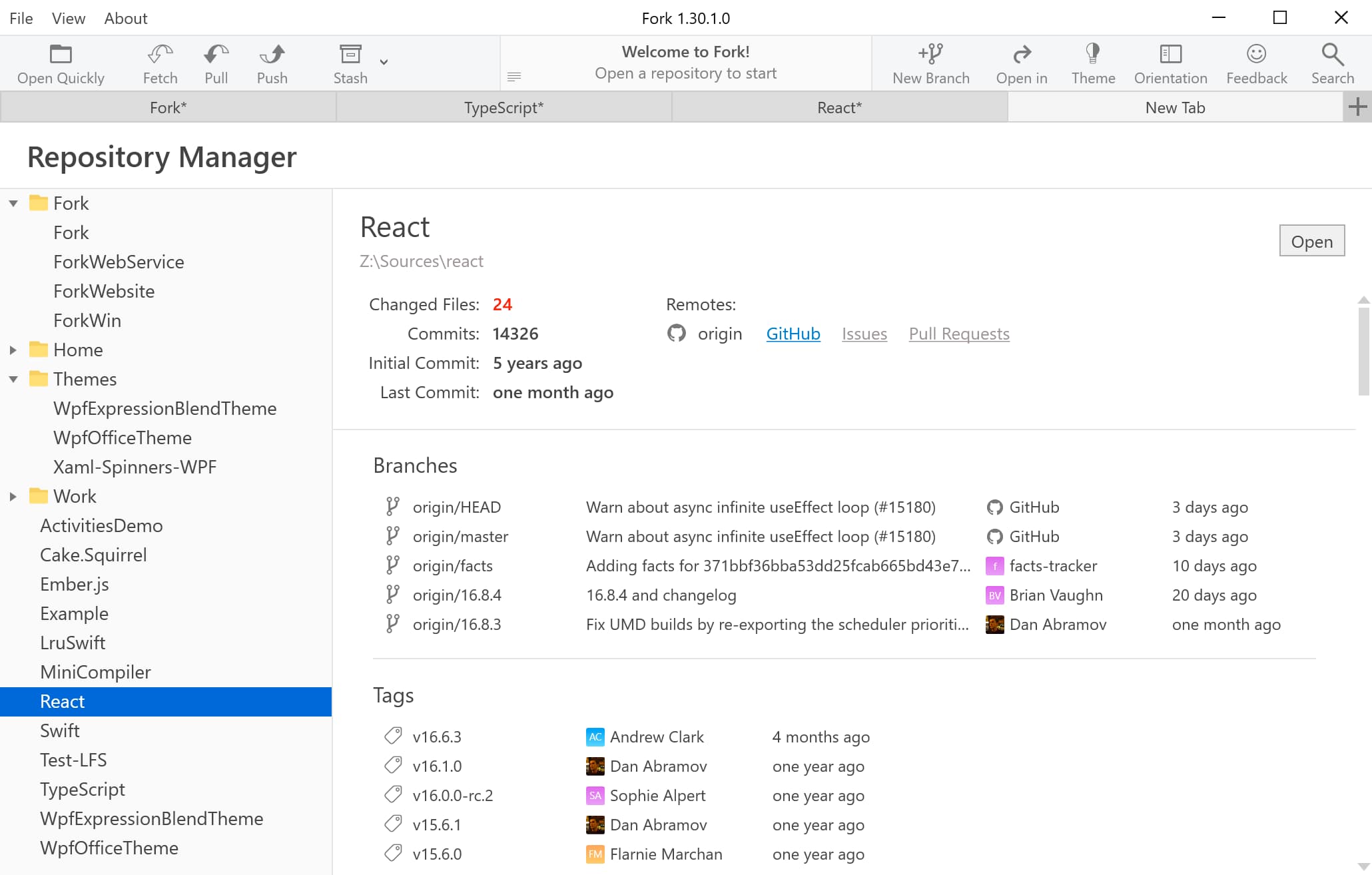
Before you create a Git repository, you'll want to create a project folder in your source directory. Once you have a folder in your source directory, you can click on File then Create new repository in Fork to create your Git directory. To check whether the Git repository is created, you can open up the project folder and check for a.git folder. Fork is a fast and simple git client for Mac and Windows, and Presslabs friendly, too. In this tutorial, we will show you how to easily set up and make changes to your site's source code using Fork, an open-source git client for Mac and Windows, which you can download here. Overall, Fork doesn't actually bring too much new to the table, pretty much all the features I've seen in other Git clients as well. However, it seems to support the subset of features I care about and does it really well. It kind of feels like what SourceTree should have been if they hadn't ruined it in 2016.
In software engineering, a project fork happens when developers take a copy of source code from one software package and start independent development on it, creating a distinct and separate piece of software. The term often implies not merely a development branch, but also a split in the developer community, a form of schism.[1]
Free and open-source software is that which, by definition, may be forked from the original development team without prior permission, without violating copyright law. However, licensed forks of proprietary software (e.g.Unix) also happen.
The word 'fork' has been used to mean 'to divide in branches, go separate ways' as early as the 14th century.[2] In the software environment, the word evokes the fork system call, which causes a running process to split itself into two (almost) identical copies that (typically) diverge to perform different tasks.[3]
In the context of software development, 'fork' was used in the sense of creating a revision control 'branch' by Eric Allman as early as 1980, in the context of SCCS:[4]
Creating a branch 'forks off' a version of the program.
https://bestdfil208.weebly.com/duplicate-file-finder-pro-6-5-pro.html. The term was in use on Usenet by 1983 for the process of creating a subgroup to move topics of discussion to.[5]
'Fork' is not known to have been used in the sense of a community schism during the origins of Lucid Emacs (now XEmacs) (1991) or the BSDs (1993–1994); Russ Nelson used the term 'shattering' for this sort of fork in 1993, attributing it to John Gilmore.[6] However, 'fork' was in use in the present sense by 1995 to describe the XEmacs split,[7] and was an understood usage in the GNU Project by 1996.[8]
Free and open-source software may be legally forked without prior approval of those currently developing, managing, or distributing the software per both The Free Software Definition and The Open Source Definition:[9]
The freedom to distribute copies of your modified versions to others (freedom 3). By doing this, you can give the whole community a chance to benefit from your changes. Access to the source code is a precondition for this.
3. Derived Works: The license must allow modifications and derived works, and must allow them to be distributed under the same terms as the license of the original software.
In free software, forks often result from a schism over different goals or personality clashes. In a fork, both parties assume nearly identical code bases, but typically only the larger group, or whoever controls the Web site, will retain the full original name and the associated user community. Thus, there is a reputation penalty associated with forking.[9] The relationship between the different teams can be cordial or very bitter. On the other hand, a friendly fork or a soft fork is a fork that does not intend to compete, but wants to eventually merge with the original.
Eric S. Raymond, in his essay Homesteading the Noosphere,[12] stated that 'The most important characteristic of a fork is that it spawns competing projects that cannot later exchange code, splitting the potential developer community'. He notes in the Jargon File:[13]
Forking is considered a Bad Thing—not merely because it implies a lot of wasted effort in the future, but because forks tend to be accompanied by a great deal of strife and acrimony between the successor groups over issues of legitimacy, succession, and design direction. There is serious social pressure against forking. As a result, major forks (such as the Gnu-Emacs/XEmacs split, the fissioning of the 386BSD group into three daughter projects, and the short-lived GCC/EGCS split) are rare enough that they are remembered individually in hacker folklore.
David A. Wheeler notes[9] four possible outcomes of a fork, with examples:
Distributed revision control (DVCS) tools have popularised a less emotive use of the term 'fork', blurring the distinction with 'branch'.[14] With a DVCS such as Mercurial or Git, the normal way to contribute to a project, is to first create a personal branch of the repository, independent of the main repository, and later seek to have your changes integrated with it. Sites such as GitHub, Bitbucket and Launchpad provide free DVCS hosting expressly supporting independent branches, such that the technical, social and financial barriers to forking a source code repository are massively reduced, and GitHub uses 'fork' as its term for this method of contribution to a project.
Newsflow the no 1 news ticker 1 4 10. Forks often restart version numbering from 0.1 or 1.0 even if the original software was at version 3.0, 4.0, or 5.0. An exception is when the forked software is designed to be a drop-in replacement for the original project, e.g.MariaDB for MySQL[15] or LibreOffice for OpenOffice.org.
In proprietary software, the copyright is usually held by the employing entity, not by the individual software developers. Proprietary code is thus more commonly forked when the owner needs to develop two or more versions, such as a windowed version and a command line version, or versions for differing operating systems, such as a word processor for IBM PC compatible machines and Macintosh computers. Generally, such internal forks will concentrate on having the same look, feel, data format, and behavior between platforms so that a user familiar with one can also be productive or share documents generated on the other. This is almost always an economic decision to generate a greater market share and thus pay back the associated extra development costs created by the fork.
Torrent ms project 2013 mac. A notable proprietary fork not of this kind is the many varieties of proprietary Unix—almost all derived from AT&T Unix under license and all called 'Unix', but increasingly mutually incompatible.[16]SeeUNIX wars.
The BSD licenses permit forks to become proprietary software, and copyleft proponents say that commercial incentives thus make proprietisation almost inevitable. (Copyleft licenses can, however, be circumvented via dual-licensing with a proprietary grant in the form of a Contributor License Agreement.) Examples include macOS (based on the proprietary NeXTSTEP and the open source FreeBSD), Cedega and CrossOver (proprietary forks of Wine, though CrossOver tracks Wine and contributes considerably), EnterpriseDB (a fork of PostgreSQL, adding Oracle compatibility features[17]), Supported PostgreSQL with their proprietary ESM storage system,[18] and Netezza's[19] proprietary highly scalable derivative of PostgreSQL. Some of these vendors contribute back changes to the community project, while some keep their changes as their own competitive advantages.
Forks are a natural part of the open development model—so much so that GitHub famously plasters a 'fork your own copy' button on almost every page.See also Nyman, Linus (2015). Understanding Code Forking in Open Source Software (Ph.D.). Hanken School of Economics. p. 57. hdl:10138/153135.
Where practitioners have previously had rather narrow definitions of a fork, [.] the term now appears to be used much more broadly. Actions that would traditionally have been called a branch, a new distribution, code fragmentation, a pseudo-fork, etc. may all now be called forks by some developers. This appears to be in no insignificant part due to the broad definition and use of the term fork by GitHub.
To add your supply request file, do the following:
From your BitbucketStationSupplies in Bitbucket, click Source Screenshot on mac is not working. to open the source directory. Notice you only have one file, supplies.txt, in your directory.
A. Source page: Click the link to open this page.
B. Branch selection: Pick the branch you want to view.
C. More options button: Click to open a menu with more options, such as 'Add file'.
D. Source file area: View the directory of files in Bitbucket.
From the Source page, click the More options button in the top right corner and select Add file from the menu. The More options button only appears after you have added at least one file to the repository. A page for creating the new file opens, as shown in the following image.
A. Branch with new file: Change if you want to add file to a different branch.
B. New file area: Add content for your new file here.
Enter supplyrequest in the filename field.
Select HTML from the Syntax mode list.
Add the following HTML code to the text area:
We are requesting additional supplies. Please send us the following:
- space ice cream
- nerf darts
- telescope light shield
Click Commit. The Commit message field appears with the message: supplyrequest created online with Bitbucket.
Click Commit under the message field.
Forking projects to make your own changes lets you easily integrate your own contributions. But if you're not sending those changes back upstream—which means sending it back to the parent repository—you're at risk for losing track of them, which can cause divergent lines in your repository. To make sure all contributors are drawing from the same place, you'll need to know some principles of how git forking interacts with git upstream. In this blog, I'll introduce you to the basics, the gotchas, and even leave you with a cool tip to get you ahead of the curve.
Let me start by detailing a common setup and the most basic workflow to interact with upstream repositories.
In a standard setup, you generally have an origin and an upstreamremote — the latter being the gatekeeper of the project or the source of truth to which you wish to contribute.
First, verify that you have already setup a remote for the upstream repository, and hopefully an origin too:
If you don't have an upstream you can easily add it with the remote command:
Verify that the remote is added correctly:
Now you can collect the latest changes of the upstream repository with fetch. Repeat this every time you want to get updates:
(If the project has tags that have not merged to master you should also do: git fetch upstream --tags)
Generally, you want to keep your local master branch as a close mirror of the upstreammaster and execute any work in feature branches, as they might later become pull requests.
At this point, it does not matter if you use merge or rebase, as the result will typically be the same. Let's use merge:
When you want to share some work with the upstream maintainers you branch off master, create a feature branch. When you're satisfied, push it to your remote repository.
You can also use rebase instead, then merge to make sure the upstream has a clean set of commits (ideally one) to evaluate:
If you need to squash a few commits into one you can use the awesome rebase interactive at this point.
After the above steps, publish your work in your remote fork with a simple push:
A slight problem arises if you have to update your remote branch feature-x after you've published it, because of some feedback from the upstream maintainers. You have a few options:
upstream.merge the updates from upstream in your local branch which will record a merge commit. This will clutter the upstream repository.Rebase your local branch on top of the updates from upstream and do a force push onto your remote branch:Personally I prefer to keep the history as clean as possible and go for option three, but different teams have different workflows. Note: You should do this only when working with your own fork. Rewriting history of shared repositories and branches is something you should NEVER do.
After a fetch, git status shows you how many commits you are ahead or behind of the synced remote branch. Wouldn't it be nice if you could see this information at your faithful command prompt? I thought so too so I started tapping with my bash chopsticks and cooked it up.
Here is how it will look on your prompt once you've configured it:
And this is what you'll need to add to your .bashrc or equivalent—just a single function:
You can enrich your bash prompt with this new function, ahead_behind, to have the desired effect. I leave the colorization as an exercise for the reader.
Sample prompt:
For those who like details and explanations here is how it works:
We get the symbolic name for the current HEAD, i.e. the current branch:
We get the remote that the current branch is pointing to:
We get the branch onto which this remote should be merged (with a cheap Unix trick to discard everything up to and including the last forward slash [ / ]):
Now we have what we need to collect the number of counts for the commits we are ahead or behind:
We use the age-old Unix tr to convert the TAB to a separator |.
That is a basic walk-through on git upstream — how to set up a git upstream, create a new branch, collect changes, publish with git fork, and a sweet tip for how many commits ahead/behind you are of your remote branch.
Bitbucket Server includes fork synchronization which basically relieves the developer from all the burden of keeping up to date with its forks, and Bitbucket Cloud has an easy 1-step sync check it out! Copy locked files with robocopy using b parameter.
Follow me @durdn and the awesome @Bitbucket team for more DVCS rocking.


/image%2F6198346%2F20210214%2Fob_17a150_fonepaw-iphone-data-recovery-5-6-0-9.png)
/image%2F6198346%2F20210214%2Fob_bbc2c5_4k-stogram-2-6-4-download-instagram-ph.png)
/image%2F6198346%2F20210214%2Fob_fc735f_flinto-1-4-download-free.jpeg)
/image%2F6198346%2F20210214%2Fob_6c1232_path-finder-file-manager-for-macos-9-0.jpeg)